About Steel
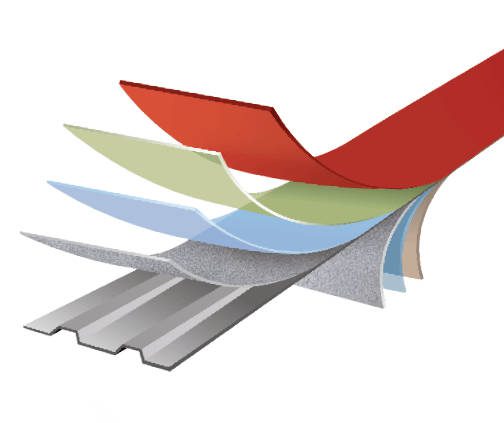
Because the traditional carbon/iron steel alloy is rust-prone when exposed to the elements, steels used for the metal roofing industry are coated with a specific thickness of another metal or alloy on both sides of the base carbon/iron steel strip. The process used to accomplish this is called the hot-dip process and involves running the steel through a molten bath of the metal to be applied. The hot-dipped process is a cheaper, more efficient alternative to a similar process with which you may be pretty familiar: electroplating.
Steels, then, are classified and named according to the metals applied. The base of galvanized steel is carbon/iron steel with a metallic coating of zinc. The zinc coating offers two kinds of protection: galvanic or barrier. Galvanic protection is a self-sacrificial process by which the metal coating gives itself up, rather than allowing the base metal to corrode. Barrier protection aims to keep the elements from reaching the base metal.
In the metal roofing industry, galvanized steel is used more often than any other metal and has a great affinity for holding paint. Because zinc provides galvanic protection, scratches on galvanized steel are somewhat self-protected or “band-aided,” preserving the steel from rust. Therefore, the life span of galvanized steel depends largely on the thickness of its metallic coating; the more zinc, the longer the steel can remain protected and rust-free.
Coating thicknesses
G-90, the most common zinc thickness used in the metal roofing industry, means that 0.90 ounces of zinc are coated per square foot of steel surface. Lesser grade-galvanized steels are G-30 and G-60 and should usually be avoided for residential applications. Always check the manufacturer’s specifications to determine the thickness of the steel’s metallic coating.
It is important to note that G-90 only refers to the thickness of the zinc coating, not the thickness of the steel itself. That thickness is measured in gauge number (26-gauge, 24-gauge, etc.) and depends on the profile of the steel metal roofing product to be used. Regarding the overall metal thickness, the higher the gauge number, the thinner the metal.
With a few exceptions, such as mill-finished shingles or other metal roof styles, all galvanized steel systems are coated with a base paint coat of some sort. In addition, many of the higher-quality galvanized steel metal roofing products, especially shake, shingle, and tile systems that are used largely on residential applications, come with an added “post-forming” coat to help protect against corrosion in areas where the metal had been refashioned during the manufacturing process.
Galvanized steel is not a good option for homeowners in coastal areas or areas with an above average amount of corrosive elements in the air. Salt air from the ocean and other elements can speed up corrosion and shorten the life of galvanized steel.
Galvanized Steel Summary:
Application: most often used in commercial, agricultural, and industrial buildings.
Advantages: strong, lower cost, comes in almost any look.
Disadvantages:
- Shorter life span than other metals
- Will rust prematurely on non-vertical surfaces (i.e anything that is not a wall, such as a roof.
- More difficult to work with: Not very malleable, needs to be cut with a shearing action rather than saw cut. The valleys, end wall, side wall, and eaves all need to be cut during installation, leaving an open edge of raw steel where moisture will wick into the roof. These are prime areas for water run-off that eventually leads to rusting. Skylights require cutting cut around and flashing, yielding yet another area of potential rusting.
Thicknesses: 26-28 gauge (0.018” – 0.014”) are most common for shake, shingle, tile, and slate profiles. 24 gauge (0.024”) is most common for standing seam systems, with a good amount of 26 gauge as well.
Weight: Between 100 and 150 lbs. per square (one square = 100 sq. ft.).
Recycled Content: Typically around 35%.