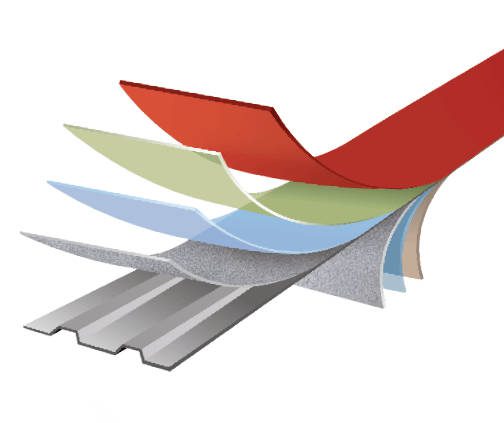
In most cases, the coatings are applied to the metal roof systems before the manufacturer or contractor sees the metal. Specialized roll-coating facilities clean the material, chemically etch and coat it, and then bake it to ensure the coating adheres to the metal and remove any remaining solvent. They then ship the metal in coils to a manufacturer to form it into profiles.
Coating Components
In the metal roofing industry, coating consists of three main components:
- Pigment (also referred to as “solids”), gives the coating its color
- Solvent, the liquid medium that is baked off after the coating has been applied
- Resin, which binds the pigment to the surface after the solvent is gone.
The finishes used in the metal roofing industry are classified by the quality of their resins.
Types of Finishes
There are three main types of finishes used in the metal roofing industry.
- Water-based acrylic emulsions. While the least costly, they are also among the lowest quality of coatings and will carry a relatively weak warranty against fade and chalk (if warranted at all). Acrylic emulsions are typically two-coat systems, consisting of a primer coat followed by a topcoat.
- Polyesters, including formulations such as siliconized modified polyester (SMP). Polyesters are also lower cost and last only slightly longer than acrylics before fade and chalk are noticeable. SMPs are higher quality than more generic polyester paints
- Polyvinylidene fluoride (PVDF) coatings are usually sold and applied to metal as the trade names Kynar and Hylar. PVDF is a two-coat system with a primer followed by a topcoat. To use the Kynar 500 or Hyar 5000 trade names, the formulation must consist of standard 70% Kynar or Hylar resin. There is no substantive difference between Kynar PVDF and Hylar PVDF resins. They are manufactured by two different companies and thus marketed under two separate trade names.
Kynar 500 / Hylar 5000 finishes usually carry a 30-year fade warranty up to five Delta E units. A Delta E unit is the smallest recognizable color shade shift seen by the naked eye. PVDF represents the highest quality coatings available for use on metal roof systems. Most metal roofing manufacturers and contractors would never recommend selecting a residential product that uses something other than a PVDF – Kynar 500 or Hylar 5000 finish.
Additional Coating Protection Available
In addition to these base coating options, many steel shake, shingle and tile profiles include an extra layer of coating to add both beauty and functionality to the products. The two coatings are applied “post-forming,” meaning after the profile is fashioned by the manufacturer. In addition to creating a gorgeous look, these post-forming coats, is that they help seal off any cracks or fissures in the zinc or zinc/aluminum coating over the steel that may have occurred during the fashioning of the profile.
The two main options here are stone coatings and Kynar powder coatings. Stone-coated steel products (also called “aggregate” or “granular” coated) are used extensively for residential applications, primarily on the West Coast and in the Southwest. These attractive coatings present a multi-hued, textured appearance and are primarily used on shake and tile profiles. The coatings consist of ceramic-coated sand or stones, which are bonded to the base steel and then covered with a clear acrylic coating.
The other post-forming coating option, the Kynar powder coat, is an electrostatically applied Kynar powder coat baked into the base Kynar coat. The result is a beautiful, long-lasting, scratch-resistant, multi-hued coat that represents the pinnacle of modern coating technology. We call this coat the ThermoBond Textured Finish.
Reflective Pigment
The newest development under the “coatings” headline is probably the most exciting due to its potential impact on the entire roofing industry: reflective pigment technology. These specially formulated pigments, were first developed by the military to help camouflage tanks against infrared detection. They are able to reflect a much larger percentage of the sun’s rays even in darker colors. This capability means that the attic absorbs less heat, therefore requiring less energy to keep the home at a comfortable temperature during the hot summer months. The result is a reduction in the home’s energy bills! Classic Metal Roofing Products is the first and only specialty residential roofing manufacturer to incorporate this technology into all its product lines. Classic calls this technology Hi-R, for highly reflective. Other manufacturers are marketing their versions under various names. Stone coating manufacturers are developing this technology as well
Please note that all galvanized steel, Galvalume, and aluminum roofs should have some sort of protective coating on the backside of the metal. A low-cost coating is often sufficient here and, in many cases, may be colorless.