


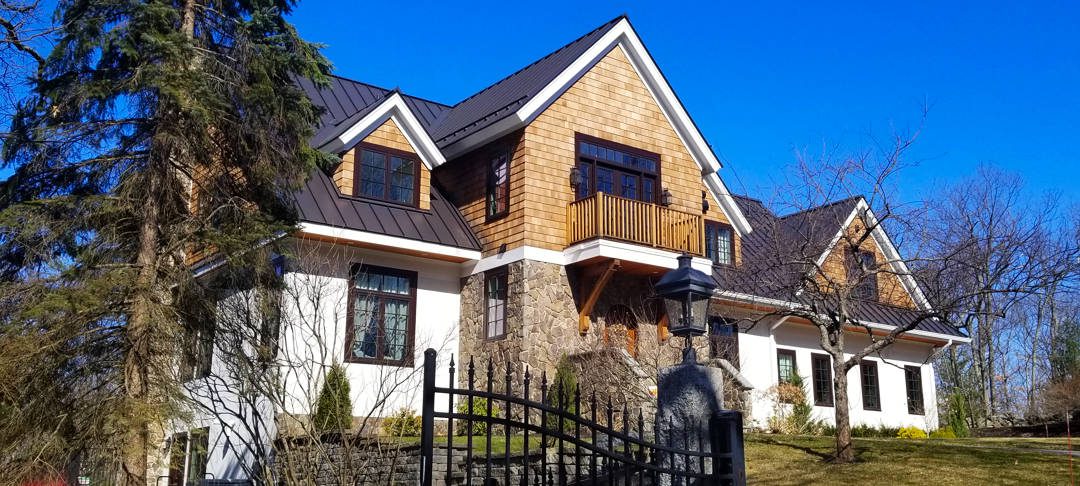
The Ultimate Guide To Metal Roofing
Metal roofing offers many advantages and options for creating a long-lasting, beautiful roof that will protect your home for a lifetime. This guide aims to provide the information you need to make the best decision for you and your home. You’ll learn about:
- Base Metals
- Types of metal roofing
- Installation best practices
- Style, color, and material options
- Mistakes to Avoid & Other Considerations
- Comparison of metal vs Asphalt roofing
Base Metals
Many people automatically assume, when they hear “metal roofing,” that the “metal” being referred to is steel. Steel is, indeed, a common metal roofing product that is widely used in Agricultural, Commercial, and Industrial metal roofing projects. However, steel is not well-suited for residential projects. Fortunately, several other higher-quality, richer metals work great for architectural residential, and institutional metal roofing projects. Let’s dive deeper into the types of metals and their best use.
Galvanized Steel
A low-cost material, galvanized steel is best suited for commercial, agricultural, and industrial buildings. This steel comes in varying thicknesses and types of zinc coating. The big downsides to galvanized steel are the propensity for rust and challenges with installation. Take a deep dive into more details in our galvanized steel article.
Galvalume Steel
Another steel often used in commercial and industrial buildings, galvalume steel has a coating made from a blend of aluminum and zinc. It is more rust- resistant than galvanized steel but does not offer as much scratch-resistance as galvanized steel. With seamed roofing, the coating is often too thin on the seam part to provide sufficient protection. As such, galvalume steel is best suited for simple profiles vs. standing seam roofs. In addition, when not cut properly, galvalume is susceptible to rust. Get more detailed information in our galvalume steel article.
Aluminum
Lightweight, durable, and corrosion-resistant, aluminum is a good option for almost any residential metal roofing system, including standing seam, shake, shingle, tile, and slate profiles. Aluminum will never rust, making it ideal for coastal applications and other areas where steel might be in danger. Aluminum’s propensity to resist rust gives it an extremely long life span. Here’s a fun fact: one of the first architectural aluminum applications was the cap on the Washington Monument in 1885.
Around this time, processes to separate aluminum from bauxite and then manufacture building-grade aluminum alloys became efficient enough to make aluminum a viable option for the building industry. Before that, aluminum had been considered a precious metal.
Today, virtually all aluminum roofing is pre-painted. You’ll find aluminum in just about any profile in which metal roofing is manufactured. In fact, more heavily formed products lend themselves very well to aluminum due to its high malleability and the fact that heavy forming adds additional structural strength.
Aluminum roofing is usually manufactured from a mostly recycled material, a majority of which is post-consumer material, such as beverage cans. One square of aluminum roofing (0.019” thick) can use as many as 1,152 aluminum beverage cans – closing the recycling loop.
At Classic Metal Roofs, our selection of aluminum roof styles includes Rustic Shingle, Oxford Shingle, Standing Seam, and Victorian Diamonite, all of which are manufactured from aluminum. We offer thick aluminum, including .0019”, .024” and .032” for shake, shingle slate and tile and .032” for standing seam roofing.
Aluminum is lightweight and more energy efficient than other metals. To learn more about the advantages of aluminum roofs, see our article on Aluminum vs. Asphalt.
Copper
Considered by many as one of the most attractive metal roofing options – especially here in historic New England, copper can add beauty and interest to a home’s exterior. Unfortunately, it carries a pretty hefty price tag as well. Rarely used over an entire residential roof, copper is mainly used for accents, bay windows, on dormers, or other areas where a touch of elegance is desired. Copper is often used on institutional buildings, Banks, Universities, Church steeples, cupolas, and the like. Learn more about copper roofing in our article, Copper Roofing Essentials.
Terne (II) and TCS (II)
This type of steel has a zinc-tin alloy (ZT) coating over base carbon steel. Original Terne metal consisted of a lead-tin alloy coating over base carbon steel and was used extensively in the 18th and 19th centuries as a residential roofing material. Today, Terne II, the new version of the metal and is often selected for historical residential retrofit projects. TCS II, Terne Coated Stainless, is stainless steel coated with the ZT alloy. It looks very similar to Terne’s dull gray color, but is more durable (and a bit more costly).
Terne II is initially a dull gray color and over time, acquires a weathered gray patina that yields a historical charm. Terne is very durable and corrosion- resistant – it will last for centuries, but the cost is high, similar to copper.
Zinc
When a project calls for extraordinary quality and greater performance, zinc may be the right solution. More architects and designers are using zinc in wall and roof construction due to its adaptability and malleability. Made to last, maintenance-free, durable, and sustainable, zinc has been used on roofs for hundreds of years in Europe – especially France and Germany – and is making huge inroads here in the United States on residential projects.
Zinc starts out as a dull silver gray and patinas into an attractive charcoal color. It is mostly commonly used in standing seam, but some companies now offer preformed zinc shingles as well. These roofs can be stunning on residential projects, but come at a substantial cost.
Other Exotic Metals
Some other metals available for roofing include stainless steel and titanium. Generally, roofs made from these more exotic metals will be architect- specified and custom-formed by a manufacturer for a particular application. If you are interested in one of these more specialized metals, contact metal roofing manufacturers to check on availability and suitability for your end use.
Terminology and Product Types
Most of the consumer confusion concerning metal roofing products stems from subtle differences between the product types and a lack of knowledge of their optimal application. And, the terminology of the metal roofing industry can be a bit intimidating for the average homeowner. In this section, we explain technology, terms, and discuss types of products used in today’s metal roofing industry.
Structural vs. Architectural
Most residential metal roofing products fall under the blanket definition of Architectural. The most important consideration for architectural metal roofing products is ensuring that the design guarantees that the roof efficiently sheds water while accentuating the other architectural elements of the home.
Architectural Metal Roofing
What sets architectural metal roofing products apart from structural ones is that they are applied over solid decking (which provides support) and are manufactured from thinner metals than structural metal roofing products. By design, architectural products pass rooftop weight loads through to the roof decking beneath them rather than support weight loads and pass them through to the building’s structural members.
Architectural metal roof systems allow for standard attic ventilation methods as well as hot roof applications.
Structural Metal Roofing
These roofs serve as a complete roof. As such, structural metal roofing products are installed without a solid decking beneath them. They are generally used in applications where the metal roofing is installed over purlins, also known as lathe boards. The spacing of such purlins is a function of the structural strength of the metal roofing and is determined through load tables supplied by the roofing manufacturer. Because they are designed as part of the “structure” of the building, structural metal roofs are manufactured from thicker metals.
Structural metal roofing is generally intended for commercial applications such as university buildings, industrial facilities, strip malls, warehouses, and other industrial applications. Rarely are structural metal roofing products used for residential applications. Because of the potential for direct contact with the backside of the roofing panels and warm, moist air inside the structure, special ventilation issues can exist with structural metal roof systems, especially on smaller buildings. Be sure to discuss this issue with your roofing contractor if you are considering a structural metal roof.
Steep vs. Low Slope
Roof pitch factors are stated in terms of rise over run. For example, 3:12 refers to a roof that is framed such that, for every 12 feet the roof goes back horizontally (“run”), it will “rise” 3 feet vertically. A simple image here would be a great addition.
The industry defines “steep-sloped roofing” as anything with a pitch of 3:12 or greater. Virtually all metal roofing products are appropriate on steep sloped applications; however, 3:12 is usually the minimum pitch for which shake, shingle, slate, and some tile profiles. In heavy snow load areas, some shake and shingle products are appropriate only on pitches of 4:12 and higher. Steep-slope roofing products are also referred to as “hydrokinetic” because they are designed to shed water.
Most standing seam profiles will work on low slope roofs down to 2:12 pitch. Any roof with less than a 2:12 pitch requires a mechanically seamed profile to help ensure water-prevention tightness. Typically used on commercial buildings, the availability of these products for residential use may be limited.
Such very low-sloped roofing products are said to be “hydrostatic,” because they allow for pooled water without allowing it to penetrate the structure.
Some homes have a combination of steep and low-sloped roof sections and use a combination of metal roofing products to appropriately accent the different roof configurations. For example, a homeowner may choose a metal shingle profile like Rustic Shingle for the majority of the roof and select a standing seam profile for a portion of the roof, such as an overhang over a porch that is low-sloped.
An installer should never use a metal roofing product on a roof with a lower pitch than that recommended by the roofing manufacturer.
Installation Best Practices and Considerations
Before you hire an installer, first ensure that the contractor is qualified to install the roof to the manufacturer’s specifications. Keep in mind that residential metal roofing is a rapidly growing industry with frequent new entrants. Look for an installer that specializes in metal roofing and has proven expertise and, most importantly, numerous satisfied customers. Installing a metal roof is not a job for a handyman or even in most cases, a general contractor!
Roofing Attachment types: Through-Fastened vs. Clip-Fastened Systems
With a through-fastened roofing attachment, the installer screws or nails through the actual roofing material and into the roof itself. Though installers typically use rubber grommets to provide a seal around the exposed fasteners, weather fluctuations inevitably cause expansion and contraction of the material and often lead to leaking and other problems.
With clip-fastened roofs, the installer attaches clips to the roof deck and then connects the actual roof product to the clips, which are underneath the roof material. This method provides far better protection against water leakage and potential changes in the appearance of the roof such as oil-canning.
Because clip fastening does not penetrate the roof, it allows for the full expansion and contraction of the metal. This flexibility ensures that the roof stays looking good for years. In addition, clip systems enable watertight protection of the roof. As such, many manufacturers offer lifetime warranties.
You’ll find more details about fastening systems in this article.
Coatings
The coating on a metal roof can make a big difference in the long-term appearance and durability of the roof. Most coatings get applied by specialized industrial firms that us roll-coating equipment to apply color (pigment), solvent (that initially adheres the pigment to the metal), and resin (which binds the pigment to the roofing material.
The three types of coatings most commonly used in metal roofs include:
- Water-based acrylic emulsions
- Polyesters
- Polyvinylidene fluoride (PVDF)
PVDF is a two-coat system with a primer followed by a topcoat, and often go by the trade names Kynar 500 or Hyar 5000. These coatings offer the best protection available and often come with a 30-year fade warranty.
For additional details, see this article on roof coatings and finishes.
Underlayment
Most contractors use asphalt-based 15-lb or 30-lb felt underlayment regardless of the roofing type. While inspectors will likely allow felt underlayment, new polymer underlayment products are much lighter and easier to install for the contractor. In addition, they offer full protection while the roof is exposed.
Polymer underlayments also last much longer than asphalt-based 30-lb. felt and provide a second line of defense against the elements. In hot weather with a standing seam roof, the asphaltic-based 30-lb. felt may stick to the backside of the panels. As those panels expand and contract, the underlayment can tear. Most responsible contractors, if they do use 30-lb. felt with metal roofing applications, will use a “slip sheet,” most commonly red rosin paper, between the 30-lb. felt and the backside of the panels. With polymer underlayments, this slip-sheet is not necessary.
Additionally, many contractors will use specialized self-adhering ice and water barrier underlayments near the eaves and down the length of all valleys. In colder climates with heavier snow loads, these products may be used over the entire roof. Building codes in certain areas will mandate the use of at least some of this type of underlayment material.
In all cases, the underlayment used beneath metal roofing should have a smooth, nongranulated surface because granulated surfaces can cause damage to the back of the metal roofing panels over time.
At Classic Metal Roofs, we recommend the use of “Roof Top Guard” underlayment for conventional vented roofs and a “breathable” underlayment for hot roof systems where a vapor barrier is not needed.. Along with a premium self-adhering high-temperature ice and water shield.
Profiles
With metal roofing, you can achieve dozens of unique looks. From traditional, sleek, standing seam panels, to old-world tile, to agricultural corrugated, the options are nearly endless. In fact, the variety of attractive metal roofing profiles is one of the reasons many homeowners choose a metal roof.
Here we’ll cover the basics, but to take a deeper dive into profile types, see our article Roofing Profiles and When to Use Which Ones.
Sheet Roofing
The defining characteristic of all sheet roofing is large panels (or sheets) of varying widths and lengths that overlap and have exposed fasteners. Sheet roofing can be installed, painted or unpainted, and is the most economical type of metal roofing. However, it is not as long-lasting, either functionally or aesthetically, compared with some other types of metal roof systems.
Standing Seam
Perhaps the most recognizable profile of metal roofing for both commercial and residential projects is standing seam, which provides a very contemporary, distinctive look, and is chosen to complement homes of all styles. Standing seam panels come in a range of widths.
Shake, Shingle, Tile, and Slate
For a long time, standing seam was the main type of metal roofing available. But lately, the industry has witnessed a surge in popularity of the “new metal roofs” – the shake, shingle, tile, and slate profiles. There are four different types of “modular” panels which vary greatly in terms of look and use. They include:
- Metal shakes – designed to mimic the look of hand split cedar shakes. S
- Metal shingles – a lower-profile design that blends in with a more modest neighborhood look.
- Metal tile profiles – offered in a wide variety of looks and feels, from the exotic Mediterranean barrel tile look to the stately S-Serpentine look
- Metal slate profiles – replicate the look of natural slate.
Some other, more exotic profiles, such as diamond shapes, scalloped, and flat tiles, are available in metal roofing.
Common Issues & Concerns When Installing a Metal Roof
Selecting and purchasing a new roof is a significant event for any homeowner. Those homeowners who do their research and have complete information available to them make wise investment choices when it comes to roofing. The following are several concerns that arise somewhat frequently during the roofing decision-making process. If you have questions or concerns that are not addressed here, please feel free to contact us directly.
Installing Over Existing Roofing Materials
Due to their low weight, many metal roofs can be installed over existing roofing materials, including old composition shingles. Additionally, the formation of many of the heavily profiled shake and tile patterns of metal roofing even permits installation over wood shingles or wood shakes.
Before deciding to install over an existing roof, be sure to consult the manufacturer or an experienced contractor, as weight is not the only consideration. In many cases, building codes prohibit more than two layers of roofing. That said, some building inspectors will waive that restriction for metal roof layover installations. If there is an existing weight problem with the structure or if there is an uncertainty regarding the integrity of the structure or roof decking, be sure to consult an expert and have those issues addressed before installing over the existing shingles.
In some cases, particularly with wood shingles and shakes, the contractor can remove the old roofing from the edge perimeter of the roof and even replace it with fresh lumber before proceeding with the roof installation.
Metal can also sometimes be installed over existing slate and asbestos slate roofs, though, again, be sure to consult with the manufacturer or an experienced contractor. Existing tile roofs and, in most cases, existing metal roofs, require removal before installation of the new roof.
Lightning
It is common for homeowners to wonder whether a metal roof might attract lightning. The basic physics is that while metal conducts electricity, it does not “attract” it. There is no evidence that metal roofing puts a home at greater risk of a lightning strike. Typically, lightning will strike the highest object in the vicinity, and rarely is that the top of the house. Still, metal roofs can be grounded by a lightning protection specialist if desired.
Fire Safety
Most metal roofs are approved for Class A, B, and C fire ratings. In some cases, meeting certain code and fire classification requirements will require a special underlayment. However, metal roofing is widely recognized for its resistance to airborne sparks and burning debris.
Sound Transmission
Most residential metal roofs are installed over solid decking, and in most cases, there is an attic space beneath that. These factors help reduce noise transmission and avoid objectionable noise from rain hitting the roof. Additionally, more heavily profiled metal roof styles are very good at breaking up any “soundboard effect.” While rain may create a slightly louder sound hitting metal roofing than other products, it will not create a “tinny” sound. If your home has areas where there is no attic space or insulation, talk to your metal roofing contractor to learn about ways to add insulation for sound deadening as well as energy efficiency.
Ventilation
In most cases, metal roofing does not increase the need for attic ventilation. However, it also does not decrease it. Homes today are built more airtight than older homes, resulting in moisture getting trapped inside the house. This moisture generally migrates to the attic and needs to be exhausted out year-round, as does the excessive attic heat, which can build during the summer months. The best proven method of venting is a combination of soffit vents and a roof ridge vent. Most metal roof systems will offer some sort of ridge vent option. If moisture is not vented from an attic, unhealthy and damaging conditions, including mold and rot, can occur.
In the rare instances when structural metal roofing (i.e., metal roofing that is installed over purlin or lathe rather than solid decking) is used on a residential-scale building, good ventilation is critical to prevent the collection of condensation on the exposed bottom side of the roofing panels.
Stress Skin “Sandwich” Panels
Increasingly, homes are being built from stress skin panels, which consist of foam sandwiched between two layers of decking or outer decking and inner gypsum board. These panels can pose potential condensation issues because they often do not have any venting. This approach goes against the International Building Code, which requires a 1′′ vented airspace in the United States and 11⁄2′′ in Canada. Before proceeding with the installation of any roofing over stress skin panels, consult with the panel manufacturer, roofing contractor, and building officials to ensure that your contractor is taking steps to avoid condensation issues.
Hail
Metal roofing is widely respected for its hail resistance. While there can certainly be storms that would damage any roof, metal roofing offers good protection from leaks, even if aesthetic damage occurs. The most widely accepted test of hail resistance is Underwriters Lab (U.L.) 2218, a steel-ball drop test that simulates the effect of hail impact on roofing products. Metal roofs pass U.L. 2218 at Class IV, the highest rating. As a result, homeowners in many hail-prone states with metal roofs can obtain discounts on their insurance premiums. Additionally, unlike other roofing materials, metal roofing resists hail damage even as it ages.
Walkability
Most metal roofs are safe to walk on without damage. However, before stepping out on your new roof, be sure to ask your roofing contractor about the correct methods for foot traffic on the roof. Some of the shingles and shake-style metal roofing products have optional foam backers for even greater rigidity and walkability.
Environmental Impact
Metal roofing is increasingly being recognized for its many “green” benefits. The durability of metal roofing makes it a very sustainable product. Additionally, should it ever need to be removed in the future, it is 100% recyclable. Most metals used in roofing have very high initial recycled content. This is as high as 95% with aluminum. The production of metal from recycled stock also has very low embodied energy in comparison to producing metal from original ores.
With the onset of various “cool roofing” initiatives in the country, metal is being recognized for its ability to keep buildings cooler in hot weather. The combination of reflectivity and emissivity, often enhanced by coatings on metal roofing, is what provides the cooling effect.
Additionally, shake, shingle, and tile profile metal roofing products have minimal contact with the home’s structure, blocking heat transfer by conduction as well. Finally, the ability to install metal roofing over old roofing materials means that landfills are not being burdened with the old roofing.
Warranties
Metal roofing has a long history, with many metal roofs over 100+ years old still around in the United States today. Those older roofs did not have the benefit of today’s coating and manufacturing technology. Metal roofing manufacturers provide warranties covering such items as manufacturer’s defects, product integrity, and coating integrity. The coating warranties may include such items as fade and chalk.
Proper Installation
As is the case with any building material, metal roofing must be properly installed to be durable and retain its aesthetic. Homeowners are encouraged to fully investigate both the metal roofing materials they are considering and the contractors they are considering for installing those materials. This investigation should include looking at past jobs and talking with past customers. If the manufacturer and/or the contractor are unwilling or unable to share information with you concerning proper installation procedures, find someone who will.
Benefits of Metal Roofing
Metal roofing offers many benefits to homeowners. As you investigate various products, the manufacturers and suppliers should be very happy to provide you with details as to the particular benefits and attributes of their products. In short, metal roofing offers strong benefits, including:
- Distinctive Beauty
- Increased Home Value
- Worry-Free Lasting Durability
- Fire Safety
- Low Weight
- High Wind-Resistance
- Energy Efficiency
- Recycled Content, and 100% Recyclable Installation Over Existing Roof Eliminates
- Ice Dams and Leaks
- Does not Support Moss or Fungus Growth Pest resistance
Further Information
Thanks for taking the time to learn more about metal roofing. If you require additional information, we would like to invite you to call (1-866-660-6668) or email us with any questions.
You can also visit our website at ClassicMetalRoofs.com where you’ll find useful articles and technical bulletins covering various aspects of metal roofing.
At Classic Metal Roofs, LLC, we take our position as a leader in the residential metal roofing industry seriously and will do all we can to ensure the ongoing success of our industry. That’s why we offer our experience and expertise to you at no charge, even if you are purchasing a competitor’s product.